What the Data Shows
Between 2020-2024, I analyzed 1,569 Gulf Coast Marathon finishes where runners had split timing data. By comparing the pace from the first six-mile split to the overall average pace, the pattern was unmistakable: runners who started aggressively paid a steep price in the final 20 miles.
Here’s what happened:
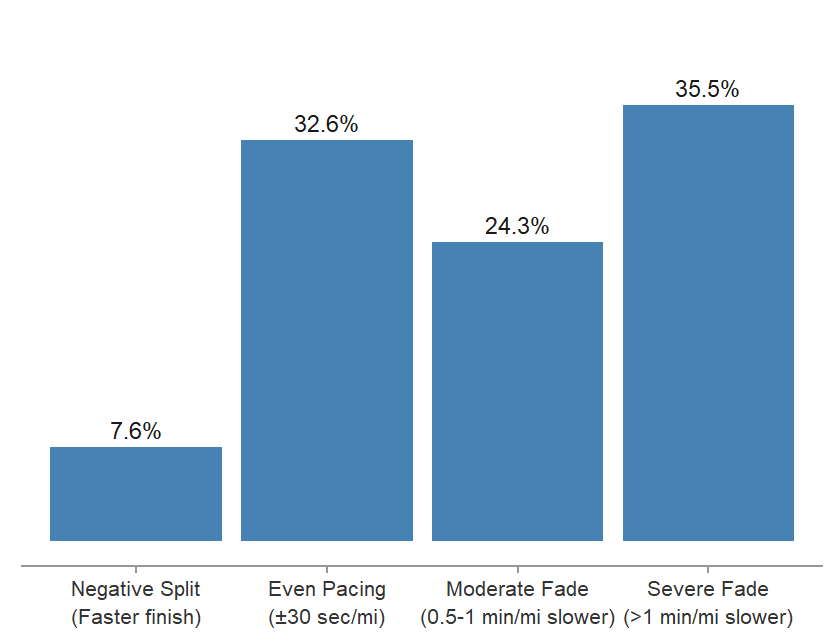
The typical runner slowed by 0.67 minutes per mile from their first split to their overall average pace. Only 7.6% managed to negative split, while 35.5% faded by more than a full minute per mile.
What Drives Your Marathon Pace?
I analyzed six factors across 1,500+ marathon finishes:
Your demographics (gender and age)
Race day temperature at the start
How much temperatures rose during the race
Whether you went out too fast in the first six miles
Here’s what I found: These six factors alone explained nearly half of the variation in finish times.
Think about that—with training plans, fueling strategies, gear choices, and hundreds of other variables at play, just these six factors capture about 43% of the performance puzzle. That tells you how much weather and pacing strategy really matter.
Here’s what stood out:
Temperature Change Matters More Than You Think
For every degree Fahrenheit the temperature rises during your race, you’ll slow down by about 1.6 seconds per mile (based on the regression coefficient of 0.027 minutes per mile).
What this means for a full marathon:
5°F warming = ~3.5 minutes slower overall (0.7 sec/mi × 26.2 miles)
10°F warming = ~7 minutes slower overall (1.6 sec/mi × 26.2 miles × 10°F)
15°F warming = ~10.5 minutes slower overall
Here’s the key insight: This is separate from the starting temperature effect (which adds 1.0 second per mile per degree). A race that starts at 60°F and climbs to 70°F hits you twice—once for starting in warmth, and again for the 10-degree rise during the race.
Going Out Fast Is Expensive
For every minute per mile you go out faster than your overall average pace, you pay a 1.4 minute penalty on your overall pace.
Translation: Start 30 seconds per mile too fast? You’ll likely finish 42 seconds per mile slower than if you’d paced evenly.
What This Means By Performance Level
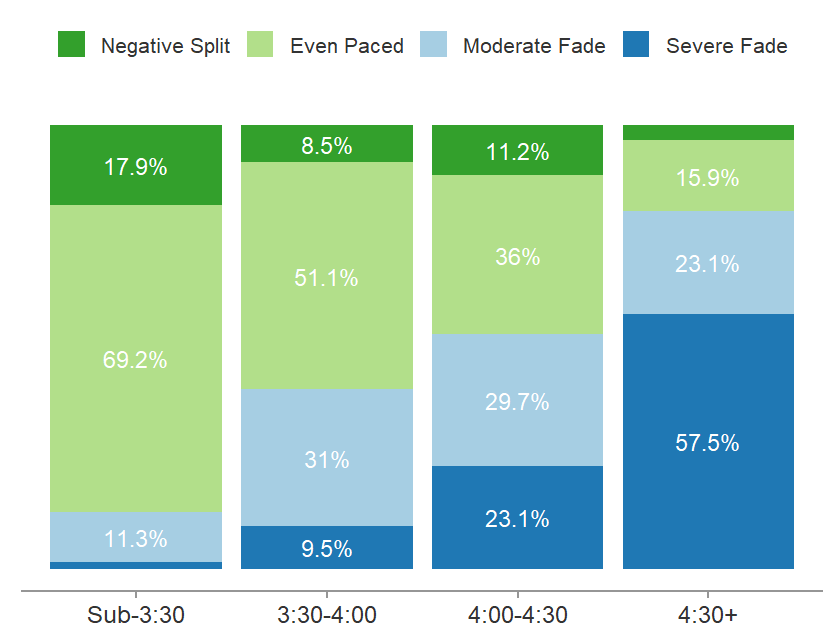
Slower runners struggled more with pacing discipline. Among 4:30+ marathoners, 57% faded by more than a minute per mile, compared to 1.6% of sub-3:30 runners.
Temperature Made It Worse
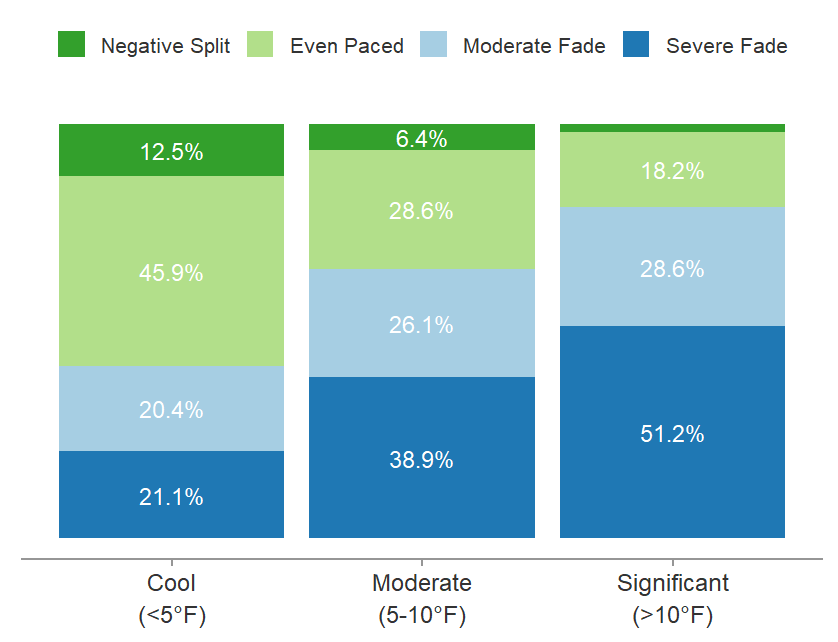
On days with significant warming (>10°F), 51.2% of runners experienced severe fading versus 21.1% on cooler days. The combination of going out too fast PLUS rising temperatures was particularly brutal.
Practical Race Day Advice
1. Adjust Your Target Pace for Predicted Warming
If the forecast shows 10°F+ warming during your race:
Conservative approach: Start 15-20 seconds per mile slower than your goal pace
A 10°F warming costs ~16 seconds per mile (1.6 sec/mile × 10°F)
Add buffer for individual heat sensitivity and you’re looking at 15-20 sec/mi adjustment
Moderate approach: Start 10-12 seconds per mile slower
Accounts for the direct temperature impact with minimal safety margin
Best for runners who’ve trained in similar conditions
Aggressive approach: Start at goal pace but prepare mentally for 7-10 minute slowdown
At minimum, acknowledge the warming will cost you time
Don’t panic when you start slowing at mile 15-18
2. The First 10K Is Not a Victory Lap
Your watch will feel easy in the first 6 miles. That’s the point.
Rule of thumb: If you’re running more than 10-15 seconds per mile faster than your goal pace at mile 6, you’re borrowing time from mile 20-26—with interest.
The penalty is severe: For every minute per mile you go out too fast, you’ll pay a 1.4 minute per mile penalty overall. Go out 30 seconds too fast? Expect to finish 42 seconds per mile slower than if you’d started at goal pace.
3. Calculate Your Temperature Tax
The model reveals two separate temperature penalties:
Starting temperature: ~1 second per mile per degree F
Racing at 60°F vs 50°F = 10 seconds per mile penalty (4.4 minutes total)
Temperature rise during race: ~1.6 seconds per mile per degree F
10°F warming during race = 16 seconds per mile penalty (7 minutes total)
Combined impact example:
Start at 55°F, finish at 65°F (10°F rise)
Starting temp penalty: 55°F × 1 sec/mi = 55 seconds/mile
Warming penalty: 10°F × 1.6 sec/mi = 16 seconds/mile
Total: 71 seconds per mile slower = 31 minutes over the full marathon
4. Know Your Personal Heat Tolerance
Traveling from a cool climate to a warm destination race? The model suggests you’re at higher risk for fade regardless of fitness.
Strategy for destination marathoners:
Arrive 3-5 days early if possible for partial heat acclimation
Prioritize hydration from 48 hours before the race
Consider that your “training pace” was established in different conditions
5. Even Pacing Isn’t Conservative—It’s Smart
Only 39.6% of runners managed to stay within 30 seconds per mile of even pacing. But those who did likely finished closer to their potential.
The math is brutal: There is a 1.4× multiplier on aggressive starts.
Start 20 seconds per mile too fast → finish 28 seconds per mile slower overall (20 × 1.4 = 28)
Start 30 seconds per mile too fast → finish 42 seconds per mile slower overall
Start 1 minute per mile too fast → finish 1:24 per mile slower overall
Even pacing eliminates this penalty entirely.
The Bottom Line
Marathon pacing is physiologically unforgiving, and weather amplifies the consequences of poor strategy.
If you’re racing Gulf Coast Marathon (or any marathon with potential warming):
Check the hourly forecast, not just the start time temperature
Calculate the predicted temperature change during your race window (typically 3-5 hours)
Add 1.6 seconds per mile for every degree of warming to your target pace
5°F warming = add 8 sec/mi (3.5 min total)
10°F warming = add 16 sec/mi (7 min total)
15°F warming = add 24 sec/mi (10.5 min total)
Start conservatively—the penalty for going out too fast (1.4× multiplier) is worse than the temperature penalty
The runners who finish strong aren’t lucky. They’re disciplined in the first half and honest about the weather.